RETURN TO UFO PAGE | E-MAIL ME
AN
APPRAISAL of MAJESTIC DOCUMENT SOM1-01
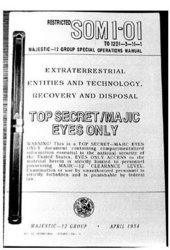
While perusing the book table at a recent UFO event here in Denver, an interesting little book caught my eye. There, not two feet away from me, sat a very official looking little pamphlet entitled EXTRATERRESTRIAL ENTITIES AND TECHNOLOGY, RECOVERY AND DISPOSAL or, more precisely Majestic 12 Group Special Operations Manual SOM1-01. Apparently a clandestine copy of a super secret government manual that promised to “prove” everything the UFO community had been telling me about Roswell and things like government cover-ups, crashed UFOs, and recovered alien bodies all these years, it was like finding a winning lottery ticket!
It seemed too good to be true, and it immediately brought a few questions to mind. For example, how could the government be stupid enough to write all this stuff down and put it into a single booklet, especially considering the explosive nature of the material? And, for that matter, how could a document that supposedly contained the most sensitive secrets of our government come into the possession of UFO groups all over the country, thereby demonstrating that there was a hole in our government's document security procedures big enough to drive a lawyer's ego through (as well as left me wondering what other vital secrets might be floating around out there waiting to turn up)? And, finally, it left me wondering why no one from the government seemed particularly concerned that local UFO clubs all over the country were selling their top secret documents from a book table at the back of UFO events. After all, if genuine, the thing is technically government property and, as such, subject to immediate seizure. Even though it was dated April of 1954, it was still classified and even carried a label on the front warning that the “examination or use by unauthorized personnel is strictly forbidden and is punishable by law.” Since I assume I'm one of those “unauthorized personnel” it's referring to, I immediately wondered if having the book in my possession wouldn't compel a SWAT team to kick down my door and haul me off to the pokey. However, noticing that no one else seemed to be sharing my concerns (or perhaps they had just failed to see the warning) and intrigued enough to want to see what was in it, I shoveled over my five bucks and beat a hasty retreat for the exit before I was nabbed by some eagle-eyed G-Man.
Now for those not familiar with this book, it turns out that SOM1-01 is part of a larger body of writings known mysteriously as the "Majestic Documents": a collection of top secret government correspondence supposedly written by top political and military leaders of the forties, fifties and sixties concerning the question of UFOs—or, more specifically, dealing with the recovery and examination of crashed UFOs (and, sometimes, their dead crews). Obviously, if authentic, they blow the lid off the entire UFO/Government cover-up conspiracy thingey as well as confirm fifty years of ufology legend. Pretty heady stuff, that. As such, I was pretty anxious to see what it had to say, and after I managed to shake the government limos that I'm certain were trying to follow me after I left, I got home and took a look at it.
What follows are own opinions concerning the likelihood of this thing being authentic and by no means should they be considered the last word on the subject (unless you want them to be). Further, I admit that I'm no expert on documentation verification, forensics, handwriting analysis and all that stuff, and since I have no authentic top secret government manuals on hand to compare the book to, my opinion is not based on anything like cold, hard science. Still, I have worked with sensitive material in the past (while in the Navy and later with Lockheed Martin Astronautics) so I'm not a complete boob either (emphasis on complete). As such, between what little I do know and going with my gut instincts, these, then, are my impressions as to the authenticity of SOM1-01.
First
Impressions
The first thing that struck me about SOM1-01 is that there's not much to it
in terms of reading material. Even at sixty pages total (thirty double-sided),
it's a quick read. Of course, part of the reason is that every other page is
taken up with a giant official sounding warning—a repeat of the dire consequences
of the front cover warning but in more menacing letters—making it really
only thirty pages long. Actually, if you include the TOC, an “Author's
Caveat” at the end of the book, a single page Appendix of references along
with a few government-ese bookkeeping pages—oh, and a couple of pages taken
up by the quite possibly the worst photo reproductions in history and a couple
of blank inventory sheets (evidence that the thing was definitely put together
by a bureaucrat), that leaves just twenty-one pages of actual text (scratch
that—I forgot about the two inexplicably blank pages at the back of the
book.) Nineteen pages of reading material in all, then. For five bucks. I immediately
smelled rip off….
Although
it did force me to wonder how much the government could know if they could manage
to squeeze the whole thing onto nineteen, 6 by 9 inch pages, the size of the
thing is not the problem. What really caught my attention almost immediately
was the way it is written. Government documents are infamous for containing
alot of official-sounding jargon like: “in accordance with Op Manual 240-R3”
and “pursuant to DoD OpDir 14-A” and stuff like that, but this one
has very little of such nonsense. They're also famous for being about as dry
a prose as one is likely to encounter on a printed page, but SOM1-01 has an
almost conversational feel to its writing style—even chatty and opinionated
at times—making it appear to have been written more by some aspiring writer
whose talents were clearly being wasted at DoD than by the traditional Government
bureaucrat. Further, it uses unusual words that one doesn't normally come across
in government documents. One example is in the section describing aspects of
various aerial phenomena on page 25 where it says: "Speed: stationary
to fantastic." Now when's the last time any government document used
the word "fantastic" to describe anything? "Official" jargon
is always more precise—even when it's just a guess. For example, it would
say something like: "Speed: stationary to transonic (or Mach 5+)"—it
would certainly never use the term "fantastic"—but maybe I'm
just being picky.
There
are other instances of non-traditional verbiage sprinkled throughout the thing,
but that's not the biggest problem. The thing that struck me as even more unusual
as I got further into it was how simplistic and poorly laid out it is. The information
it contains appears too basic and easily surmised to be of any real value, while
the sections seem to be randomly inserted without much consideration being given
to any coherent order. For instance, the section about craft and alien body
recovery procedures is sandwiched between sections that discuss UFO and alien
body types and a lengthy chapter on aerial phenomena in general, which didn't
make any sense to me. If the manual is about recovering crashed alien craft—as
the title suggests—why then go into superfluous detail describing different
types of aerial phenomena? Such information would be of only minimal relevance
to the crash at hand and would be akin to writing recovery procedures for crashed
experimental aircraft and including a brief summary of the history of aviation.
Shouldn't such peripheral information be in separate manuals or, at very least,
attached appendixes? Every government document I've ever read is fairly clear
as to the contents within it and stick to the subject matter pretty closely.
Detailing saucer types and understanding the problems various aerial phenomena
produces falls more into the category of “nice to know” information,
giving these sections the feel of filler more than anything else.
I
also found it unusual that the manual has no concluding remarks. It just abruptly
ends after the aerial phenomena section with no wrap up, which even for a government
document is untypical. I suppose there could have been more to it at one time
and the information just didn't make it through the process (hence the blank
pages?) but there's no way of telling since the pages don't carry the typical
“page 3 of 25” type numbering system that most government documents
do. (Oh, and by the way, every government manual I've ever seen stamps
“This page intentionally left blank” on every blank page to prevent
someone from inserting a page of spurious information into the manual. Like
the old adage goes, the devil IS in the details.)
All-in-all, I found SOM1-01 a pretty light weight read that presented little more than basic security procedures (the craft retrieval process, for example, are probably not much different from those one would use for a downed experimental military plane) and some basic info about UFOs that anyone could acquire from the pulp literature of the era. There was nothing in it that couldn't be easily surmised by even a newly minted 2nd Lieutenant or learned in an hour-long briefing. Certainly, if a real government document, it is not a good example of tax dollars being put to good use.
Anachronisms
Okay, for those who don't know what an anachronism is (and no, it's not the
Latin term for a spider), an anachronism is something that is out of place in
terms of customs or technology or, even, language (i.e. “At that point,
General Washington embarked upon his jetski and crossed the Potomac...”)
They're particularly useful for determining the authenticity of a story or,
in this case, a document, so I was especially on the lookout for such things
in SOM1-01. While I confess that I didn't find many such faux pas (since there
isn't much text in the thing at all) I did find a few.
The
first was on the cover itself, where the term “extraterrestrial” is
used in the title (it's also used elsewhere throughout the book). I don't know
exactly when the term first came into common usage, but I suspect it was sometime
after 1954 (the date of the manual). In fact, I think it was a term one wouldn't
have been likely to stumble across until the late sixties or early seventies.
Most likely a government document of the era would have referred to such beings
as either alien, non-terrestrial or, more likely, as simply “unidentified”.
I could, be wrong about that, however, so don't sue me. Proponents of the book's
authenticity also make much of the fact that it refers to flying saucers as
UFOBs throughout (something that supposedly people in the 1950s did—although
it's still not clear to me what the “B” stands for); however, I just
happened to notice that the heading for Chapter Six (and by the way, since when
do official documents use chapters? They're normally divided into sections)
is entitled GUIDE TO UFO IDENTIFICATION. Not UFOB as throughout the rest of
the document, but UFO. Sounds like a slip up to me (made all the more conspicuous
by the “Section I UFOB GUIDE” heading seen immediately beneath the
chapter heading). Another problem I noticed was that the manual included the
triangle-shaped saucer among its "common types" even though, as far
as I know, the “boomerang” type saucers are a more contemporary variety.
Of course, it's possible there were a few triangular-shaped saucers spotted
in the forties that simply didn't make it into the public record, but even the
manual notes that such types are rare, making one wonder why one would include
what could only be considered an anomaly in a general field manual?
Another
little blooper I found is on page nine, where it tells us in no uncertain terms
that the machinegun-totting guards patrolling the perimeter around the crash
site are to be augmented with “electronic surveillance” devices. In
1954? That was a time when televisions were still the size of small automobiles
and things like motion sensors, electronic trip wires, and surveillance cameras
had yet to be invented (unless they reversed engineered something from a previously
crashed UFO, of course).
But the most notable anachronism I came across was on page eight. There, in the part about Press Blackouts (or How to Deceive Everyone by Making Up Stories No One Will Believe) it instructs our eager UFO debunker to use “downed satellites”—along with meteors, weather balloons (what? No swamp gas?) and crashed military aircraft—as cover stories. The problem, of course, is that the manual was written three years before Sputnik, and as such long before anyone outside of the astronomy community knew what a satellite was. As such, the first question from the press when invoking the “fallen satellite” alibi as a cover story would have been: “What's a satellite?” Oops.
Recovery
Techniques
But the biggest problem with the manual, in my opinion, is in the almost casual
way it handles debris recovery and body retrieval procedures. While it goes
into great detail about how to do such mundane things like inventorying and
crating recovered wreckage and bodies (it's even got a blank “Extraterrestrial
Technology Packing List” on page thirteen in case you run out of the conspicuously
less useful MJ Form 1-006 on page twelve) there's not very much about how to
handle the material itself (beyond being sure to wear gloves). For example,
it says nothing about marking and cataloguing each fragment on a grid map, noting
its position in relation to other fragments, taking precise measurements of
each recovered peice or other such potentially useful bits of information. Instead,
it basically just says pick everything up, throw it in a box (and if you're
shipping it overseas, be sure to throw a dessicant—misspelled, by the way;
it's really desiccant—and a pointless humidity indicator inside).
Oh, and include sufficient postage, and clean up after yourself. Then lie about
everything.
Helpfully,
there is an almost indecipherable photo on page sixteen that illustrates the
proper procedures to use when closing a box (with the ubiquitous TOP SECRET
MAJESTIC EYES ONLY stenciled across the top of the page so we can take comfort
in the fact that the Rooskies aren't going to come into possession of such sensitive
material) but not a word on what to do if everybody's skin starts to fall off.
There is, however, a nifty little piece about rendering an injured alien first
aid (“Let me get a Band aid for that tentacle there, buddy.”) and
quite a bit about securing the area (the life of the alien being expendable
if keeping it alive might compromise security—pg 18) but it skims over
the actual retrieval process itself pretty quickly. (Well, almost. I did appreciate
the instructions on page 19 that read: “Small detached pieces and material
scraped from solid surfaces will be put in jars or other small capped containers
if available.” Ed: “Hey Joe, you didn't happen to bring some tupperware,
did you? We've got some Reticulan brain tissue here!” Joe: “Heck no!
I thought you had some in your trunk!” Ed: “I did, but the wife used
them last Saturday at her pudding-of-the-month club meeting.”)
I
suspect the reality of something like a real UFO retrieval would be very different
from the “clean-up on aisle seven” procedures described in the manual.
A downed alien craft would be not only something that could easily blow up in
your face without warning and for any reason (such as perhaps having a self-destruct
mechanism built into it designed to explode if anyone gets within fifty meters
of the thing, precisely so it doesn't fall into the hands of us “primitives”)
but would be a first-class bio-hazard to boot (even without dead alien bodies
strewn around.) Without understanding what it's made of and how it works—and
especially without identifying and understanding its power source—one is
almost guaranteed to kill themselves if they start tinkering with it. For example,
what if it has a matter/anti-matter drive and one of the technicians decides
to turn off the containment field? Could get pretty messy, one might suspect.
(“Hey, Joe, whadja think this button does? No idea, Ed. Go ahead and push
it.” — Maybe that explains the Kingston, Arizona crater….)
A
real crashed UFO, in contrast, would be recovered entirely on site by
a specially trained and equipped group with the expertise—it is hoped—to
do the job right, and be treated more like an archeological dig than a NTSB
investigation. It would be a slow and tedious process that would take weeks
or even months to complete, with scores of people in clunky rubber suits slowly
and meticulously working to clear the dirt out from around the impacted vehicle
and recovering the object one tiny piece at a time (while constantly monitoring
for radiation and biohazards throughout the process.) Oh, and less you think
it might go a little faster if the thing landed relatively intact, think again.
The fact of the matter is that a relatively intact UFO would be even more dangerous,
for that would imply the onboard technology is potentially still functional
and, as such, deadly if mishandled—something that would be less of a concern
were it merely a ball of molten slag buried thirty feet in the dirt. The only
instructions that would make sense in a book of this nature—designed, as
it is, for first contact teams—is to have them cordon off the area for
miles around, not approach the wreckage at any point, and wait for the proper
authorities to arrive to do all the heavy lifting.
Of
course, it could be argued that the military wasn't as enlightened about such
things back in 1954 (anti-matter being unknown at the time) and so might have
been more rough in their handling of the material, but this seems unlikely to
me. After all, the process was—at least according to other Majestic 12
documents floating around—supposedly being overseen by the finest scientists
of the day (Bush, Einstein, Teller, Von Braun, etc.) who should have well understood
the lethal potential of such a vehicle, so this just doesn't hold water. Scientists
tend towards caution by nature; even if anxious to get their hands on some alien
technology, they would still have insisted the thing be handled with finese.
I
also found it curious that SOM1-01 makes no mention of what to do in the case
of an attempted alien recovery effort. Surely an ET civilization would be anxious
to recover their downed craft (and, especially, any bodies) so why no word on
what to do in such a event? (“Excuse me for interrupting your dinner, General,
sir, but there's a couple of bug-eyed fellows here with pulsar blasters demanding
we return their disk and there's nothing in the manual about what to do. Any
suggestions, sir?”)
But
these problems pale in comparison to a body (or Extraterrestrial Biological
Entity as they call it—EBE for short) recovery. Beyond suggesting some
packing instructions and admonishing one to wear gloves, again SOM1-01 isn't
particularly helpful about exactly what to do in regards to handling what could
only be considered the greatest bio-hazard of all time. This is really unfortunate
considering that one may be pickling an organism that could have alien bacteria
residing in one of its three stomachs that could spell the end of mankind were
it to be exposed to the air. Simply telling someone to pack the thing in ice
and make sure to keep the shipping materials intact in case you want to use
the box again (pg. 15) would not only be silly but dangerous!
In
fairness, the manual does say the body is to be handled by a specially trained
bio study unit (under the jurisdiction of something called MJ-12 OPNAC BBS-01,
whatever that is) and that these instructions are only for the “person
or unit making the initial contact”, but if so, then why give any instructions
having to do with retrieval and crating at all? It does have a disclaimer instructing
the reader that wreckage and bodies should be moved only if “the area cannot
be kept secure for an extended period of time” (pg. 9), but since when
couldn't the military keep a particular area secure for as long as they chose?
These folks have tanks and flame throwers; they can cordon off the White House
lawn if they want to! As such, all the manual should say about alien life-forms
is something to the effect that should you come across a dead alien, DON'T TOUCH
A DAMNED THING AND GET EVERYONE THE HELL OUT OF THERE! Giving a bunch of MPs
from some nearby air base the impression that they could stuff an alien corpsical
into a crate of ice and send it off on a truck is inviting disaster (something
along the lines of inadvertently introducing an influenza virus to 13th Century
Europe), so the manual would be wise to leave out all retrieval instructions
lest someone be stupid enough to try and implement them.
At least the book does have the foresight to tell us what to do in case the alien is still alive, however: in the time-honored “shoot-first-and-ask-questions-later” fashion the military is famous for, the reader is simply told to take the—probably embarrassed—ET into custody and hold it for further examination. Unfortunately, it doesn't say what to do if the thing should resist arrest or make a run for it (or begin eating people) but maybe that's in SOM1-02. Hopefully, the subject will be one of those beautiful Venusian woman you see in 1950's scifi movies, making the task somewhat more bearable (interestingly enough, the manual doesn't describe beautiful Venusian woman as one of the types of identified aliens even though they were BIG in 1954.)
Conclusion
There are numerous other discrepancies, inconsistencies, and just plain silliness
that I could go on about concerning SOM1-01, but you get the idea. After looking
over the thing and reading some chicken entrails, my final conclusion is that
it is, by all accounts, not only a fraudulent piece of nonsense, but not a particularly
clever bit of nonsense at that. Apparently written by a budding scifi writer,
it is a disjointed, incoherent collection of tripe that is about as far from
being a credible hoax as I can imagine. Of course, others will disagree for
a variety of reasons, but I find it curious that even the individual who first
foisted this atrocity upon the unsuspecting public, Don Berliner, is NOT—at
least according to the Author Caveat on page 29—inclined to regard SOM1-01
as “genuine.” Interesting that even the source for the manual considers
it a fake (he had the document mailed to him by an anonymous sender in 1994).
It does make one wonder why the mainline UFO community continues to push it
with such passion—along with the entire Majestic Documents collection in
general—when they could gain much if they would just disown the stuff and
get back to work.
Personally, as a UFO aficionado and one who believes that extraterrestrials probably have been and are even now observing us, I find it a sad testimony to the sorry state the UFO community has fallen into that so many otherwise clever people have fallen for tripe like this. This is most unfortunate, for UFOs are deserving of careful study, which I suspect will remain impossible as long as things like SOM1-01 continue to pollute the environment.