RETURN
TO 2012/PROPHECY PAGE | E-MAIL
ME
A
LIST OF GENUINE DOOMSDAY POSSIBILITIES
In
my book, 2012:
Extinction or Utopia, I make a list of the various threats that face
our planet, politically, socially, environmentally, and naturally, in an effort
to appraise just how likely any of them are really to do us in. While the prospect
of our own demise is always a guessing game, I thought the reader might find
it helpful to look over my list and judge for themselves whether they agree
with my assessments or not. Of course, you might even come up with a few of
your own that I have overlooked, in which case drop me a post and let me know.
Alright,
so just what are the threats to Mother Earth? Below is my chart of potential
threats to the planet, both man-made and natural, along with what I consider
to be their destructive potential to destroy, in turn, a global civilization,
life in general (not just human beings, but all life on the planet) and the
environment, rated on a scale of 1 to 5 (with 1 representing the lowest potential
for destruction and 5 the highest):
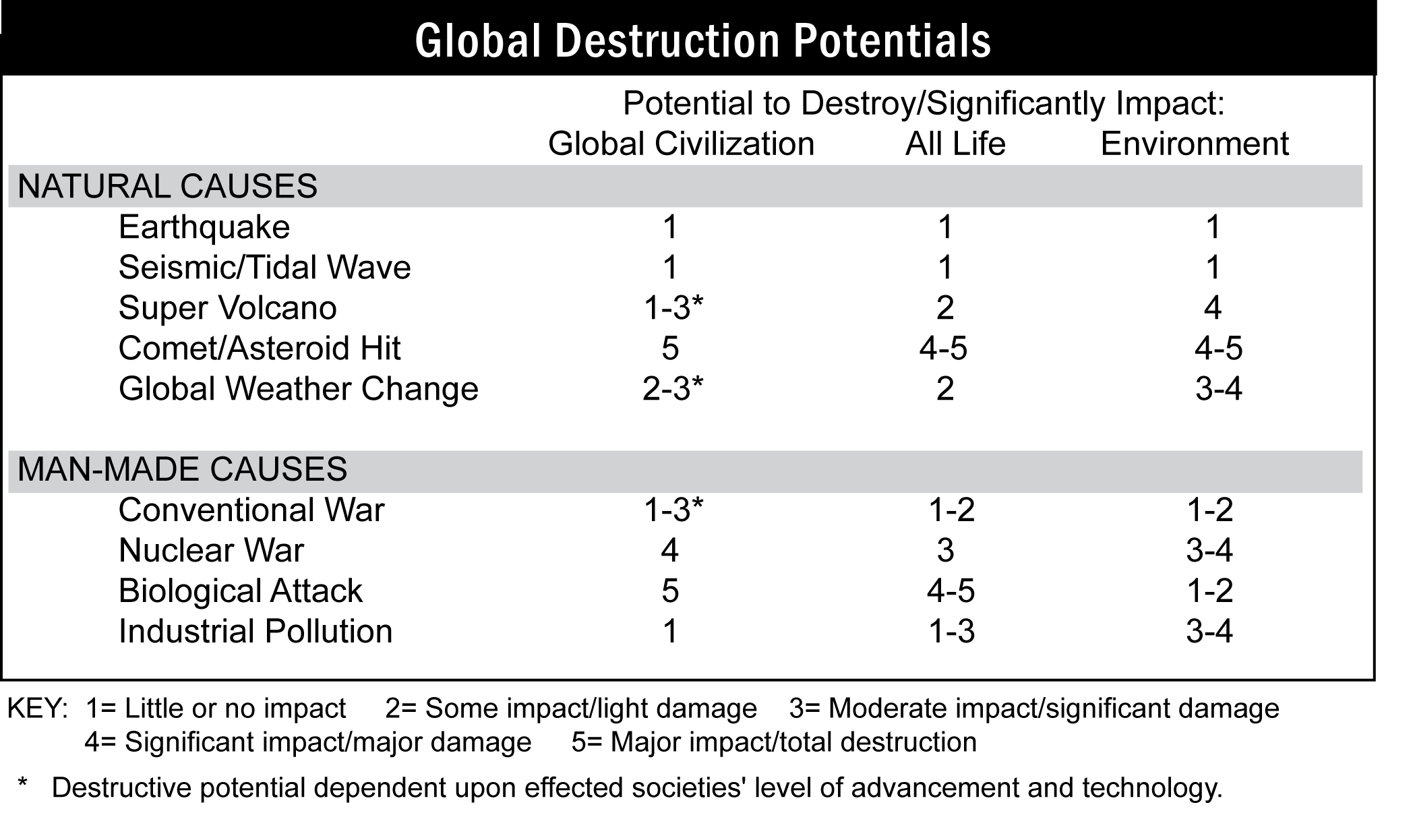
Notice
that many of the natural causes we traditionally assume to be the most destructive
are really not the most serious threats we face. Earthquakes, for example, while
extremely destructive, are localized events that may level poorly built structures
and change the flow of a river, but have almost no impact outside of the quake
zone itself. This is also true for seismic (commonly but mistakenly called tidal)
waves which, while capable of inundating miles of coastline and devastating
a coastal city, could hardly destroy all civilization on the planet. But there
are a few on the list that really could be a major threat, so let's take a closer
look. First, the natural doomsday threats:
- Super
Volcanism: An ordinary volcano, while inarguably destructive, are largely
localized events that impact only those cities and population centers within
a few dozen miles of the eruption site, and while big eruptions are notorious
for spewing millions of tons of material into the upper atmosphere, which
in turn has the ability to impact weather patterns hundreds or even thousands
of miles from the eruption site, such effects are usually short-term and
not particularly dangerous. However, there are two exceptions that could
spell—if not doomsday—certainly great hardship for the planet
in general. The first of these would be a series of large volcanoes erupting
over a comparatively short span of time whose cumulative effect could seriously
threaten crop production worldwide, potentially resulting in world-wide
food shortages and creating significant social upheaval. While there have
been periods in the geological past when this was the case, however, it
seems the likelihood of dozens of eruptions occuring in a comparative short
span of time (say several months) world-wide is extremely unlikely. Not
impossible, of course, but so remote as to be essentially a non-concern.
However, there is something known as a "super volcano", which
is an eruption large enough to devastate an entire continent as well as
drastically affecting the planet's environment for decades afterwards. The
largest one that we know about occured at Lake Toba, Indonesia, over 75,000
years ago—an eruption which may have, by some estimates, killed 60%
of all human beings on the planet and profoundly impacted the weather on
the planet for decades. Were one to occur today, it might not spell the
end of civilization, but it would certainly mess things up pretty substantially.
However, while the effects would be significant and, in areas, devastating,
our technological capability would probably enable us to offset the worst
effects, at least within the more advanced nations on the planet. Obviously,
developing nations would bear the brunt of such an event, likely resulting
in the death by famine of hundreds of millions of human beings (with livestock
deaths numbering in the billions), but within a few decades civilization—battered
and bruised, perhaps, but still quite intact—should be back on its
feet.
Fortunately, however, such eruptions are rare (at least as far as human
life-spans are concerned): the last really massive super eruption occurring
around 26,000 years ago at Lake Taupo in New Zealand. Additionally, and
as far as we can tell, only America's Yellowstone Caldera is also capable
of putting on such a show, having done so twice in the last two million
years, the latest occurring just over 640,000 years ago. Big eruptions such
as Krakatoa (and even more environmentally destructive eruptions such as
Mount Tambora in Indonesia in 1815) are essentially once-a-century events,
while the type of super eruptions of doomsday lore are once every 100,000
year events, making the prospect of doomsday coming in the form of massive
volcanic blast and a sky blackened with ash a remote one.
- Asteroids,
Comets, and Meteors: Of course, volcanoes are not nearly as popular
a doomsday scenario as is the prospect of a comet or an asteroid hitting
the planet (an especially spectacular doomsday scenario popular with Hollywood)
which, depending upon the composition and size of the celestial object,
really could spell the end. Just such an asteroid, in fact, is thought to
have exterminated the Dinosaurs some sixty-five million years ago, while
similar celestial objects may have been responsible for other mass extinctions
throughout history. As such, if we were looking for a natural agent to herald
in doomsday, this could well do it.
What makes such celestial objects especially scary is the fact that they
can theoretically appear at any time with only minimal warning (in some
cases, no more than a few weeks) and, if large enough, could truly trigger
a genuine doomsday scenario. Additionally, these objects don't need to be
especially large to do damage. According to best estimates, the one that
wiped out the dinosaurs was only about 10 kilometers (6 mi) in diameter,
which is not much bigger than Mount Everest. However, even at such a comparatively
small size, it produced a crater over 112 miles in diameter and exploded
with the energy equivelent of 100 trillion tons of TNT, or about
2 million times greater than the most powerful thermonuclear bomb ever tested!
Fortunately, ones like the monster that did in the dinosaurs are a once
every 100 million year event, so we theoretically should have another thirty-five
million years before we need to start worrying.
Fortunately, space is a big place, making the chances of a large one of
these errant rocks pelting the planet pretty remote. While estimates vary
considerably over how grave a threat asteroids and large meteors pose to
the planet, the chances of one ending life on the planet anytime soon is
variously estimated to be anywhere from one in 10,000 to as low as one in
ten million. However, large meterorites are more problematic than asteroids
because they are so difficult to detect and can appear quite suddenly. Additionally,
even a small one—say no larger than the size of a typical home—is
capable of leveling a small city, so the danger can't be entirely ignored.
Comets, however, are another story. Despite being composed primarily of
frozen gas (which makes them considerably less dense than an asteroid or
meteor) they are just as potentially destructive. By way of an example,
when the comet Shoemaker-Levy 9 hit the planet Jupiter in July, 1994, the
pieces of that comet (which was actually a shattered comet moving in formation)
entered the Jovian atmosphere at an average speed of 130,000 mph (60 km/s)
and delivered the energy equivalent of 200,000 megatons of TNT. And these
were the one kilometer-sized fragments. Some were even larger and more destructive
than that!
Additionally, there is evidence that a comet may have exploded over Earth
as recently as 1908 over the Tunguska River in Russia, leveling an estimated
80 million trees over a 2,150 square kilometer (830 square mile) area and
producing a 5.0 Richter scale earthquake capable of being detected on seismic
equipment as far away as London. Estimates of the energy of the blast range
from 5 megatons to as high as 30 megatons of TNT, with 10-15 megatons the
most likely yield (which is still a force about 1000 times as powerful as
the bomb dropped on Hiroshima, Japan in World War Two). Though science is
uncertain whether the explosion was caused by the air burst of a large meteoroid
or comet fragment, there is general agreement that the object was no more
than a few tens of meters across, but even at that size, had it hit a major
city, it would have leveled it and potentially killed millions. Not to worry,
however. Scientists estimate that small comets capable of destroying a city
only hit the Earth once every 40 million years or so. Big continent-busting
comets like that in the 1998 movie Deep Impact, are rarer still,
only hitting once every 150 million years or so. Still, one can never be
too careful so keep your eyes on the sky, bucko!
- Gamma-ray
burst: Gamma-rays are inimaginably powerful bursts of energy that result
from the merging of two collapsed stars. They are so powerful, in fact,
that if one occurred as far away as 1,000 light years, it would appear about
as bright as out own sun and would quickly cook off our atmosphere and destroy
the ozone layer. This would result in ultraviolet rays from the sun reaching
the surface at nearly full force, causing skin cancer and, more seriously,
killing off the tiny photosynthetic plankton in the ocean that provide oxygen
to the atmosphere. The problem is that such a double star is invisible to
us, meaning that if one was nearby and did burst, we would have little or
no warning, making for a true doomsday scenario. Fortunately, it appears
that such beasts are rare, with the few that scientists have observed over
the years coming from distant galaxies. And even if one went off in our
own galaxy, considering the vast size of just our own humble little Milky
Way, the chances of one occurring close enough to cause a problem is unlikely.
- Rogue
black holes: Over the past twenty years or so black holes—those
invisible little vortexes of intense gravity left over from collapsed stellar
corpses—have become increasingly popular as potential planet killers
and for good reason: even a small one could cause all sorts of problems
if it were to make its way through our solar system. So great is its gravitational
pull that it would likely alter the orbit of some of the planets and, if
it got close enough to Earth, draw us into an elliptical orbit that would
create all sorts of extreme climate swings. While the likelihood of it actually
colliding with Earth itself would be extremely remote, in a more reasonable
worst case scenario it could toss us out of our orbit entirely and eject
us out of our system. Additionally, it is estimated that there could be
as many as ten million black holes in the Milky Way Galaxy alone, making
the prospect of encountering one a little more likely.
How likely? Well, not very, actually. They don't move fast (no faster than
a normal star) meaning that if one approached our solar system we would
have decades or, if we were technologically advanced enough, even centuries
to notice its approach (which would be done by noticing minor variations
in the orbits of some of the outer planets as the beast affected their paths).
Of course, there wouldn't be much we could do about it at that point beyond
possibly evacuating the planet and heading into deep space, and in any case,
it wouldn't be a sudden event but more like a long-term doomsday scenario
that lasted for many decades.
- Giant
solar flares: Our sun is a pretty irritable cosmic partner, constantly
shooting gaseous plumes of white hot plasma thousands of miles into space
which our atmophere generously shields us from. Normally, they are not a
problem, but sometimes these plumes are much larger than normal, and are
what we refer to as solar flares (more properly known as coronal mass ejections).
Fortunately, we seldom feel the effects of these plasmic bursts (beyond
creating havoc for ham-radio users and increasing the luminosity of the
Aurora Borealis or Northern Lights). However, astronomers have occasionally
witnessed other suns in our galaxy produce something called a super flare
millions of times more powerful than their regular cousins which, if it
occurred on our sun, would turn our planet into a charcoal briquette. Fortunately,
there is persuasive evidence that our sun doesn't engage in such foolishness,
and that such massive flares seem to be confined mostly to newer stars or
to those demonstrating significant gravitational instability.
However, our sun may be capable of exhibiting milder but still disruptive
solar activity potentially capable of raising temperatures on Earth enough
to induce massive flooding or, in the case of a decrease solar activity,
lowering the temperature enough to induce a mini Ice Age (which would be
far more destructive to the world's economy than is global warming). This
is not end-of-the-world kind of stuff, however, but more of a long-term
global change problem.
- Reversal
of Earth's magnetic field: It seems that every few hundred thousand
years Earth's magnetic field dwindles to practically nothing and then gradually
reappears with the north and south poles flipped. Now this flipping of the
magnetic poles—the last one happening about 780,000 years ago—isn't
particularly dangerous, but this brief period of decreased magnetic fields
could threaten life on the planet, for without magnetic protection, particle
storms and cosmic rays from the sun, as well as even more energetic subatomic
particles from deep space, would strike Earth's atmosphere, eroding the
already beleaguered ozone layer and causing all sorts of problems to both
man and beast (especially among those creatures that navigate by magnetic
reckoning). Further, scientists estimate that we are overdue for such an
event and have also noticed that the strength of our magnetic field has
decreased about 5 percent in the past century, possibly signalling that
such an event may be in our immediate future.
However, in being so gradual, there should be plenty of time to take the
necessary precautions to avoid the most destructive effects by moving underground
or off planet, or perhaps strengthening the planet's atmospheric defenses
through the use of exotic, futuristic technologies. In any case, it isn't
something we need to worry about in the short term, though it could be a
concern for those living a few hundred years from now.
- Global
epidemics: Germs and people have generally managed to coexist in peace
for thousands of years, but occasionally the balance gets out of whack and
all sorts of unfortunate things result (such as the Black Plague that wiped
out a quarter of the population of Europe in the 14th century and the influenza
outbreak in 1918-19 that took at least 20 million lives worldwide). As such,
the prospect of a new antibiotic-resistant germ developing in nature that
could decimate the world's population again is a very real one not to be
taken lightly, especially considering the speed at which diseases can be
spread nowadays. The grimmest possibility would be the emergence of a strain
that spreads so fast that we are caught off guard or one that resists all
antibiotics, perhaps as a result of our stirring the ecological pot. In
fact, it is thought quite possible that the sudden wave of mammal extinctions
that swept through the Americas about 12,000 years ago may have been the
result of an extremely virulent disease which humans helped transport as
they migrated into the New World.
However, there is good news as well. Science has come a long way since the
14th century—and since 1919 for that matter—in understanding how
germs mutate, as well as in developing effective antibiotics for whatever
new strains come along. This trend is likely only to continue into the future
as new technologies and strategies for battling the constant assaults from
our micrscopic preditors become more advanced as well, meaning that with
luck, we should be able to stay just one step ahead of any future pandemics.
That's not to say that a particularly virlent strain of influenza or an
airborne version of the ebola virus might not someday appear to bring death
to millions (especially in less developed countries) but the prospect of
a single bug wiping out all of humanity overnight remains extremely unlikely
(though not, of course, impossible). Pass the Kleenex, please.
Okay,
that takes care of most of the natural threats, but what about those man-made
dangers we face? Could we be sowing the seeds of Armageddon through our own
technology? Let's take a look:
- Thermonuclear
War: Alright, I admit, this would be bad. Very bad. It's no wonder,
then, that such a global conflagration taking place has been the leading
preoccupation of doomsday prophets since Alamogordo and remains a shadow
we have been living under for over sixty years. Additionally, with a planet
bristling with literally thousands of warheads—some of them held in
the arsenals of governments of questionable stability and with other developing
countries in a race to produce their own weapons—such a possibility
cannot be taken lightly. But could a full-scale thermonuclear exchange really
eradicate all civilization on the planet, or are we overestimating such
a nightmare scenario's true destructive potential?
At the risk of sounding creepily optimistic, however, the best computer
models consistently demonstrate that despite the immense damage a full scale
nuclear war would inflict upon humanity and the environment, it is unlikely
to wipe out civilization in its entirety. It would set it back several decades
to be sure and in some especially hard-hit areas civilization would have
to essentially start over from scratch, but most likely humanity would survive,
especially in the more remote areas of the globe. Additionally, much of
the military and political infrastructure of the devastated countries—being
largely mobile or protected in special facilities—would likely survive
as well, thereby providing a basis from which to rebuild. While the industrial
base would be shattered and the financial foundation of the global economy
would be in tatters, as long as the basic knowledge and technological expertise
acquired over the centuries survived, civilization would be able to rebuild.
Certain areas might be rendered uninhabitable for years by radiation and
the death toll might well be in the billions when all is said and done,
but with a world population rapidly approaching the seven billion mark,
there would probably be far more survivors than victims of even a global
Armageddon. Not great, but survivable.
- Nuclear
Winter: Of course, the real danger from a thermonuclear war is not the
blast damage and radiation; these would be fairly localized (most nuclear
devices have a blast radius of between three and ten miles) and the radiation
levels would drop fairly quickly to livable levels in most areas within
a few years. What would have the greatest long-term impact would be the
effect such an exchange would have on the Earth itself. The detonation of
hundreds or, potentially, even thousands of nuclear warheads within the
span of a few hours would throw up tremendous amounts of dust, smoke, soot
and ash into the atmosphere, which would have a profound effect on the atmosphere
and could even usher in something scientists refer to as "nuclear winter".
While a controversial and not completely understood phenomenon, the nuclear
winter theory maintains that it is this secondary effect of a nuclear exchange
that would do the real damage and ultimately kill far more people than the
blasts themselves. In effect, this layer of dust and soot would be so thick,
the hypothesis maintains, that little sunlight would be able to penetrate
the gloom, resulting in a dramatic drop in global temperatures along with
a sudden inability of plants to convert light energy into chemical energy
via photosynthesis. This, in turn, would have a dramatic effect on Earth's
intricately balanced ecosystem and agriculture, resulting in the devastation
of the world's food supply and initiating a world-wide famine on an unimaginable
scale which and potentially bring humanity to the very threshold of extinction.
However, the theory has a few problems. First, we simply don't know how
much smoke and dust a full-scale nuclear exchange would throw into the atmosphere,
how evenly distributed it would be, or if it would really be thick enough
to prevent most sunlight from reaching the Earth's surface. Though we have
evidence that large amounts of dust and other particulates in the upper
atmosphere will decrease the amount of sunlight reaching the surface (the
explosion of Mount Tambora in Indonesia in 1815, for instance, threw up
so much ash that it ushered in a "mini Ice Age" that devastated
crops in New England and Europe for months afterwards) that doesn't necessarily
mean that a man-made catastrophe like nuclear war would do the same. Tambora
ejected more than 160 cubic kilometers of material when it blew. The possibility
that even 20,000 warheads exploding at once could put that much material
into the air is extremely unlikely (especially as most of these would be
airborne detonations unlikely to throw great amounts of soil skyward). Most
of what would rise into the atmosphere would be smoke and dust rather than
the heavier material ejected by a major volcanic eruption, making the denseness
of the "blanket" considerably less than the ash cloud that would
result from a super eruption. It's also likely that such a plume of smoke
and dust, driven by generally lateral air currents, would be largely confined
to the latitudes in which the majority of the detonations took place, leaving
most areas (and, probably, the poles themselves) mostly clear. As such,
it's uncertain how temperature over the entire planet would respond when
sunlight is still capable of reaching large areas of the surface. Additionally,
as the dust and smoke particles are heavier than the surrounding air, the
clouds would dissipate fairly quickly—probably within just a few weeks—as
the heavier particles fell back to Earth, eventually clearing the skies
and allowing a degree of equilibrium to return to the planet. Of course,
the clouds of smoke and ash would have profound detrimental effects on the
ecology of the planet and drastically alter weather patterns for decades
afterwards, but that these effects would be capable of extinguishing an
advanced, global society in its entirety is uncertain and still open to
debate.
- Biological
Weapons: The price of progress over the years is that today science
has the capacity to produce weapons potentially deadlier than even nuclear
weapons. Further, these deadly agents aren't explosive or radioactive, and
are even too small to be seen with the naked eye, but in the wrong hands,
they really could spell doomsday for humanity under the right conditions.
Of course, I'm referring to biological weapons, which really do posses the
capacity to kill billions, making their use a genuine nightmare scenario
if they were to ever be used.
We're not talking about chemical agents such as Tabin, VX or Sarin gas here;
while these weapons have the capacity to kill literally thousands of people
were they to be unleashed on a major population center, nerve agents are
not capable of obliterating a global civilization. Only biological agents
have the capacity to cut through a population like a scythe, leaving cities
and towns intact but utterly devoid of life. If it spread quickly enough
and was especially virulent, it could eradicate the entire population of
the Earth in a matter of months, leaving our planet entirely devoid of human
life. Considering the fact that there are terrorists out there willing to
give their lives for the "cause", the prospect of such a genetically
engineered germ falling into their hands and of them actually using them
on innocent civilians remains a reasonable cause for concern. It wouldn't
be an overnight doomsday, to be sure, but if it ended in the extinction
of humanity, it would be, for all practical reasons, the end-of-time as
far as homo sapiens are concerned.
Fortunately, however, biologically exterminating an entire population is
not easy. It takes a high degree of scientific and technological sophistication
to create a viable agent, along with a high degree of foolhardiness to use
it. People smart enough to produce such a germ are also smart enough to
know it could well come back to haunt them as well, so the reluctance to
use such a weapon would be considerable. Unfortunately, such restraints
may not stop a terrorist bent on suicide, although even a terrorist should
still recognize that the extermination of all life would be counter-productive
to their goal; after all, one cannot install a theocracy on Earth or usher
in a new age if there is no one left around to be subjected to it. Additionally,
as is the case with naturally occurring pandemics, science should have the
capacity to counter the effects of such a "super bug" were it
to ever be unleashed. This idea works from the premise that any civilization
capable of producing such a virus would presumably also possess the technology
necessary to counter it. In effect, the higher the technology level, the
more deadly the germ while, at the same time, the less chance the germ will
be successful due to an advanced civilization's ability to counter it. As
such, even if one were capable of working out the scientific, technological,
political, military and moral problems developing such an agent would entail,
its use could only be contemplated in the most desperate of circumstances.
- Biotech
disaster: One of the remarkable advances science has made recently is
in the field of genetic engineering which, when done correctly, can make
crops hardier, tastier, and more nutritious. Engineered microbes can also
ease our health problems and gene therapy offers the promise of repairing
elusive fundamental defects in our DNA, making the entire field an area
of great potential. But there's a danger as well: genes from modified plants
might leak out and find their way into other species, creating all sorts
of unanticipated and unfavorable mutations, while engineered crops could
foster insecticide resistance, making them especially vulnerable to pestilance.
And of course there's always the possibility that a terrorist group might
use such a technology to engineer an especially destructive weed (say one
capable of destroying entire crops) or of even producing a mutated form
of influenza or some other lethal pathogen. Fortunately, like bio-weapons,
such would take an extremely sophisticated laboratory to produce, and how
adversely they might impact our planet remains to be seen, though it seems
one would be wise to err on the side of caution where the manipulation of
DNA is concerned.
- Particle
accelerator mishap: Another often overlooked consequence of science
is the possibility that one of our high-tech experiments might go awry,
with all the unfortunate consequences that would entail. One of the more
unusual concerns out there is the idea that a particle accelerator—those
delightfully strange and super expensive donuts that fire atoms at each
other at light speeds in an effort to see what happens when they collide—could
set off a chain reaction that would destroy the world by inadvertently creating
a subatomic black hole that would slowly nibble away at our planet until
eventually it reduced to being just a cloud of dust orbiting the Sun.
However, just as fears that the first atomic bomb would start a sustained
reaction that would set the atmosphere on fire proved to be unfounded, scientists
claim that such concerns are likewise unfounded. The accelerators in use
today simply aren't powerful enough to make a black hole and the fact that
accelerators have been in operation for decades with nary a black hole to
show for it should also be seen as an encouraging sign. Of course, maybe
it's just a matter of building a big enough donut….
- Nanotechnology
Mishap: Though it has all the earmarks of a Star Trek episode, the fact
is that science is just a few decades away from creating self-replicating
microscopic nano-machines capable of performing surgery from inside a patient,
building any desired product from simple raw materials, and doing other
equally spectacular things otherwise beyond our capabilities. Clearly, nanotechnology
has the potential to revolutionize manufacturing, medicine, and technology
in a way scientists could not have imagined a few decades ago, making it
an exciting and promising new field of study and one likely to grow in importance
over the next few decades.
The problem is in what we don't know about this emergent technology. What
if, for example, as a result of an industrial accident, bacteria-sized micro-machines
spread through the air, replicating swiftly, and end up reducing the biosphere
to dust in a matter of days? Plus, as they would also make superb military
weapons (imagine what an army of nanobots could do to an enemy radar system
or the inner workings of a nuclear submarine) consider how destructive they
would be in the hands of terrorists. Clearly, such weapons would be disastrous
and practically unstoppable. Most who work in the field, however, consider
the threat overblown. Like the biological warfare scenario discussed earlier,
such a weapon would prove too unpredictable to use, offsetting whatever
advantages they may bring to the battlefield. Additionally, it shouldn't
be difficult to figure out how to program the little devils to turn themselves
off after a fashion, precisely to prevent such a scenario from happening
. Still, one never can be certain where such technology will lead us, what
it might be capable of doing, nor can we gaurantee we'll always retain control
over it.
- Artificial
Intelligence: Speaking of nano-technology, another related technology
has to do with the development of smart machines capable of thinking for
themselves ala Commander Data of Star Trek fame. Of course, we're not talking
about anything quite that sophisticated, but the idea of creating weapons
capable of "thinking" of ways to confound an enemies' defenses,
or a smart drone fighter capable of learning from previous engagements and
adjusting its tactics accordingly isn't far away. Clearly, thinking machines
would come in very handy in a number of ways and revolutionize our planet
if they were to come to fruition.
The problem comes, of course, as to what if these smart machines got smart
enough to decide that we're no longer necessary and do away with us clearly
inferior biological units? Obviously, with their artificially enhanced reflexes
and faster thinking speed they might prove a formidable enemy that really
could prove dangerous if there were enough units involved—an idea demonstrated
in graphic detail in the 2004 film I, Robot. Of course, that was
Hollywood's vision of the future, but the prospect of a world awash in increasingly
intelligent machines may be only a few decades away, making such a scenario
not entirely beyond the realm of possibility, especially when one consider's
man's occasional short-sightedness when it comes to the lethality of his
own inventions.
But how great a danger is artificial intelligence? It all depends on how
intelligent it is and what sort of safeguards might be built into it to
keep it from becoming a threat. First, developing an artificial intelligence
sophisticated enough to decide to do away with us "mere humans"
is still a ways off (think centuries, not decades) and so not something
we need to worry about for awhile. Second, it should be possible to program
a failsafe system into any artificially intelligent machine we create forbidding
it to harm human life (a concept proposed by science fiction author Isaac
Asimov as early as 1942); and, finally, even if they were to take over,
whose to say that smart machines might not make better leaders than humans
do?
Seriously, though, while such a prospect may be a concern for future generations,
it isn't something we need to worry about for the time being—if ever.
A bigger concern, however, would be the prospect of humans merging with
machines—that is, of humans possessing the ability to essentially download
their brains into computer-enhanced mechanical surrogates that allows them
to log into nearly boundless files of information and experiences, making
it possible for them to vastly expand their intellectual power. This would
make such a person in essence a cyborg capable of far more than even the
smartest and strongest human would be, and making them a particularly dangerous
villain if they chose to go over to "the dark side." However,
such a technology would probably be carefully regulated and monitored, and
it's likely that such "postbiologicals" would still need regular
human maintenance to keep going, so such a prospect is not a given. Also,
it's not clear how a single cyborg—even a remarkably clever one at
that—could initiate doomsday. It would still, after all, be limited
physically and presumedly still be capable of being destroyed, making the
prospect of computers ushering in doomsday most unlikely.
- Environmental
toxins: And finally there is the impact from our chemicals and waste
products to induce the grim reaper to pay a visit. Certainly the death of
thousands of people in an industrial pesticide accident in Bhopal, India
in 1984 serves as a poignant example of just how dangerous chemicals can
be. It's also uncertain how pesticides and thousands of other tons of chemicals
we dispose of everyday might effect us down the road. In high doses, for
example, dioxins can disrupt fetal development and impair reproductive function,
potentially damaging our ability to procreate and so eventually driving
humanity to extinction.
Of course, such a possibility is a very long-term doomsday prospect and
not one most people normally think of when considering end-of-the-world
scenarios, but if humanity is to one day die out, this is the most likely
path it'll take. However, the fact that we are growingly increasingly aware
of the problem that chemicals pose to us and our environment and that we
are already beginning to take steps to address it (such as shifting to non-polluting
renewable energy sources, etc.) should give us some cause for optimism.
We may never be able to omit pollutants from our civilization entirely,
but hopefully the future will be far cleaner and safer than the present
(which in turn has already proven to be far cleaner and safer than our past).
The
reader will note I leave out global warming as a possible threat, which is intentional.
The effects of global warming (or cooling, for that matter) are gradual and
uncertain, making the prospect of doomsday far less likely under this scenario.
Additionally, the science behind all the hoopla is still far from decided, and
seems to be more politically driven than scientifically valid. (Remember, it
was only a few decades ago that scientists were pretty certain we were heading
into a mini-ice age that failed to materialize, so caution where predicting
future climate trends is always a good idea.) I do devote a chapter to looking
at global warming in my book, however, in case you are interested in looking
at some of the data (probably out-dated by now, but still interesting).
TOP
| PROPHECY PAGE | HOME