RETURN TO GHOSTS PAGE | E-MAIL ME

PHOTO ANOMALIES & HOAXES

I get many supposed spirit photos sent to me, most of which prove to be fairly easy to explain away as anomalies in the film, mechanical problems with the camera, or simply misidentified objects too close to the lens. In the "spirit" of objectivity (excuse the pun) here is a sampling of some of my favorite examples of such anomalies along with explanations of what most likely happened to produce the effect you see. I'm also including some known hoaxed ghost photos for you to examine as well to help you appreciate both just how easy it is to fake a decent spirit photo as well as how clever some people are. (P.S. While most of the pictures here were sent to me personally and are used with permission of their owners, I found a few on the internet which I assume to be in the public domain. If not, let me know and I'll remove the offending photo asap.) Also, I invite you to check out my gallery of what I believe to be authentic spirit photos for a comparison...if you dare!


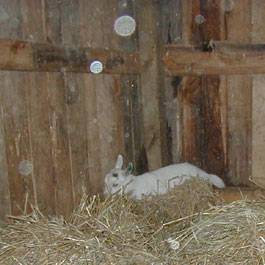
The most common type of all alleged spirit photos is the notorious "orb", which some ghost hunters consider to be little balls of energy (consciousness "bubbles" perhaps?) in their most simple form (before they acquire enough electrical energy to manifest themselves into something more recognizable). Unfortunately, they are uncommon enough that many people are stunned when they pick up something like one on a photo.

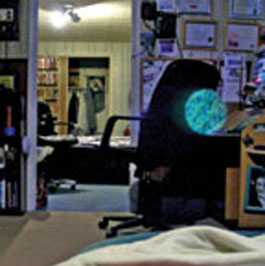
Of course, most orbs are a result of camer'as own flash reflecting off dust particles, insects, and precipitation immediately in front of the lens. Other causes are lens refraction (sometimes also called lens flare) which is a result of light hitting the lens at unusual angles, resulting in various colored glowing spheres (and sometimes other shapes) appearing in the picture (shown at right). Of course, that's not to say that ALL orbs are dust or insects, but the majority really are nothing to worry about. I do wonder, however, why they mostly show up only in photos taken at supposedly haunted locations. I seldom see them anywhere else... Hmmm. (Lens flare photo used with permission, Rocky Mountain Paranormal)
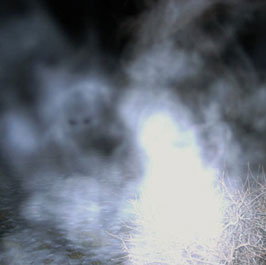
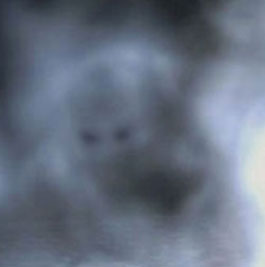
An especially common photo anomaly is known as a "vortex", which is those misty, filmy little clouds of ectoplasma commonly mistaken for manifesting spirits. Most are the result of exhaled breath (usually as a result of the photo being taken at cold, outdoor locations at night) or cigarette smoke, which is why expert ghosthunters always ensure that there is no smoking while hunting ghosts and that one always holds their breath when taking photos on cold nights. The biggest problem is that it isn't difficult to make out objects—usually faces—in the mist. Notice the apparent skull in the left center of the photo (closeup at right); a manifesting face or a trick of the eye? You decide! (Used with permission, Rocky Mountain Paranormal)
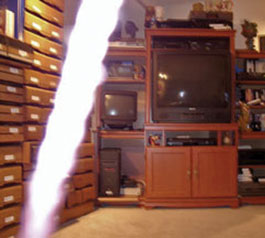
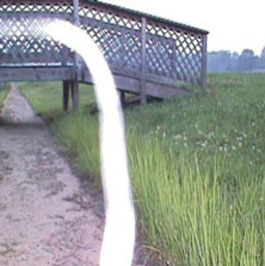
Another type of vortex is the more solid types, to examples of which are shown here. On the left the camera strap is caught in the flash (which is why expert ghost hunters always ensure that the camera strap is removed while hunting ghosts) and on the right, a strand of hair (which is why most ghost hunters are bald). You would be amazed how easily these effects can scare the bejeebers out of someone! (Used with permission, Rocky Mountain Paranormal)
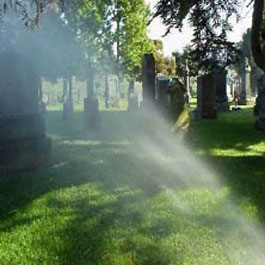
Left: another unusual vortex—this time sualight reflecting off a sprinkler in a cemetery. And on the right is another great example of human hair being mistaken for a ghostly manifestation. (Used with permission, Rocky Mountain Paranormal)
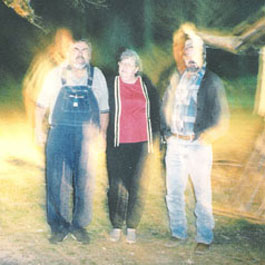
These photos show what is known as an "in camera double exposure", which is a one of the new types of photographic errors (and sometimes hoaxes) that is becoming more prevalent these days. The idea here is that the companion or blurred image is supposed to be the manifestation of a spirit that is attached to a person (supposedly that of either a deceased relative, a spirit guide, an angel or, in some cases, even a demon).

The reality behind the image is that the camera (usually a Polaroid, but it can occur on any type of camera) is using a flash while at the same time using a slow shutter speed. This can be caused by partially blocking the flash on an automatic camera or by manually setting the camera to night portrait mode or the wrong manual settings, and just slightly moving the camera while the shutter is open. This causes the image to contain two images of the subject, one that is reasonably sharp and another that is similar but, due to the transparency and blur created by the technique, will not always match the subject exactly. The fact that the blurred image doesn't look exactly like the subject makes the suggestion that the image is a "companion spirit" easier to pull off. (Used with permission.)
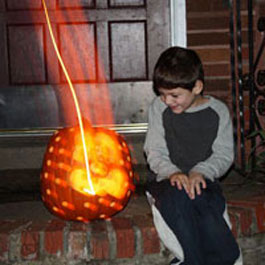
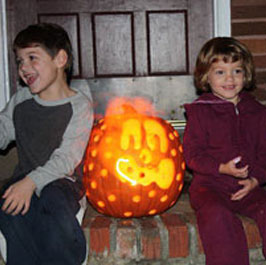
Another common effect frequently misinterpreted as a ghost picture is motion blur (sometimes called "streakers"), shown in these two very cute examples.

This occurs when the camera tries to compensate for shooting a dark subject (or someone in a dark place--usually using the "night portrait" mode) by using a slower shutter speed. What happens is that once the flash goes off, if the photographer unconsciously moves the camera ever so slightly, he or she will create the motion blur effect that you see in the pumpkins. The blur is only noticeable with especially bright colors since that is the only light source the camera can pick up without a flash, which is why the children do not appear similarly "smeared". The "lightning bolt" coming out of the pumpkin in the picture on the left is actually a blur of the candle flame itself--the bolt effect being the result of the camera being jerked slightly upwards immediately after the flash went off. Cool effect, though, and one easily reproduced with practice. (Used with permission.)
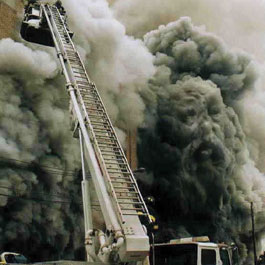
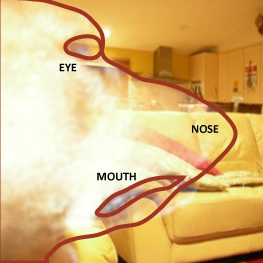
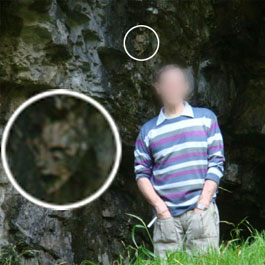
Oh no, it's pareidolia! For those unfamiliar with the term, pareidolia (sometimes referred to as "matrixing") is the brain's attempt to make out recognizable shapes where none exists. In effect, you are seeing what appears to be a face/form because that is what the brain is wired to do when confronted with random patterns of light and shadow. This is the same phenomenon we experience when we see faces or animals in the clouds, and is also the reason that the more you stare at the picture, the more "face" you see. It's really just an optical illusion. Here are a couple of really good examples.

On the left is a wonderful face of an ancient Chinese philosopher looking out from the billowing smoke of an especially nasty fire. On the right, a "demon" hiding in the rock face, obviously intent on mischief.
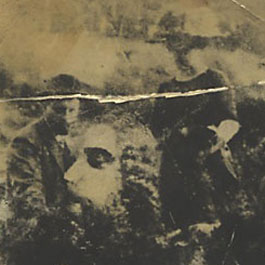
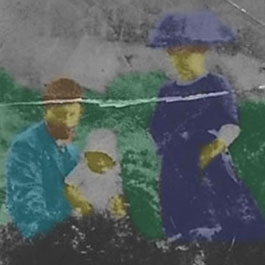
This is perhaps one of the best examples of pareidolia on record. In the original photo on the left (probably taken sometime in the late nineteenth century) we can clearly see the face of Jesus (see, and you thought there were no pictures of the Savior). On the right, however, once the subjects are highlighted by some heavy-handed coloring, you can begin to see exactly what the picture is showing. Amazing!

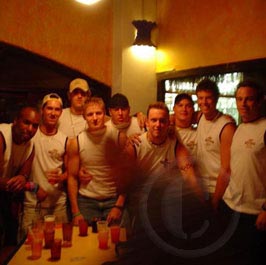
Left: This photo was sent to me by a guy taking a few photos of his friends at some resort in Cancun, Mexico. Notice the fuzzy, half image of what appears to be a man sitting at the table in front of them. No, it's not a double exposure but most likely an article of clothing flapping up in front of the lens just as the picture was snapped. Cool effect though. (Used with permission.)

Right: You gotta love Photoshop and Civil War reenactments. Here our intrepid photographer took a picture of a Civil War era wagon and then waited for someone in period costume to walk by, at which point he shot a second photo. Then it was simply a matter of cutting the figure out of the one photo, turning the transparency up, and splicing it into the wagon alone picture. Such fakes are easy to do and can look pretty authentic to the untrained observer. The biggest giveaway is the consistency of transparency of the figure; real ghosts tend to be either very solid in appearance or more solid at some points than at other points (i.e. the upper torso might appear nearly opaque while the legs and head may be transparent or even missing). They don't often appear this evenly transparent.


Left: Interesting effect of girl being caught in midstride just as the camera shutter malfunctions, giving her a blurred image. The giveaway on this is the fact that all the people in the picture appear to be blurred to some degree; by remaining relatively still, however, they don't take on the semi-transparent effect of the fast moving girl in the center. (Used with permission.)
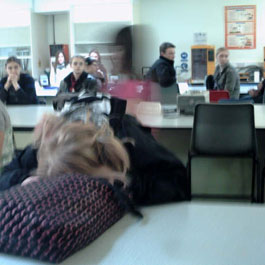
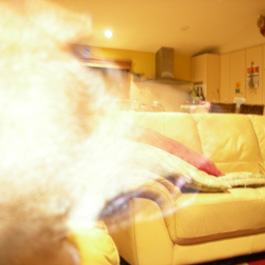
Right: Another example of the wonders of Photoshop. Dead giveaway here is the "spooky" melodramatic pose, the cast shadow, and the composition of the photo.


Photo shot in Evercreech, near Somerset, England in 2003 shows what appears to be a boy in Medieval-era clothing staring at the camera. Photographer claims she saw no one when she snapped the picture and that the figure simply appeared when developed. Since the photo made international news and the lady was even identified by name (unlike most hoaxers, who remain anonymous) I bought off on it and posted it as an authentic capture. I later had several people insist it was a Photoshopped image of Anakin Skywalker from Star Wars Episode I, but since I couldn't find the matching image and thought that the ladies' story had been checked out, I was not predisposed to accept the explanation. However, recently a friend sent me the photo at right which appears to be a perfect match for the image on the photo, demonstrating that once again I've underestimated the cunning of hoaxers and the veracity of British newspapers (which appear to be no more accurate than our own). Lesson learned.

Speaking of hoaxes, here are a couple brought to you by the folks at iPhone, who cleverly introduced a new application called "Ghost Capture". Now anyone can create their own ghostly image with the click of a button, thereby filling my e-mail with all manner of garbage. The problem is that these are actually pretty good quality images generally better than one can achieve with Photoshop, making them especially pernicious. They're so good, in fact, that recently a noted Australian psychic was fooled by one of these iPhone photos when he declared it authentic on an Aussie radio program, even managing to come up with a whole story about the child in the image, which obviously hurt his credibility to no end. There's an old adage among ghost hunters that if it looks too good to be true, it probably isn't. The problem is, what happens if someone should really manage to get a good "capture"?

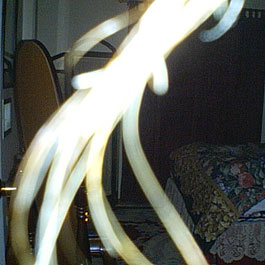
At first glance it looks like another wispy "vortex" shot of either exhaled breath, hair hanging in front of the lens, or the flash reflecting off of cigarette smoke, but look closer. I'm ashamed to admit that I didn't see it at first, but the mysterious filmy haze is actually a close-up of a dog (in this case, I'm thinking a Golden Retriever). Why is it transparent then? Is it the ghost of a dog, perhaps? No. It's simply a long exposure time and a jumpy dog who turned its head just as the flash went off. (He was probably startled by the flash and instinctively turned away from it.) Cool effect, though, and it taught me to be a little more observant and not so quick to rely on stock answers when examining spirit photos. (Used with permission.)

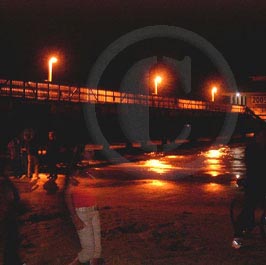
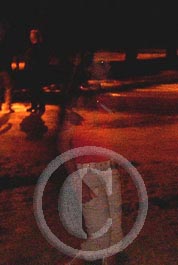
Not a Photoshop trick but a good example of how a person walking quickly in front of a camera (the girl with the white pants on the left--closeup at right) at night and with a slow shutter speed can appear transparent and, as such, quite ghostly. Would have been an especially stylish ghost had it been a genuine capture. (Used with permission.)

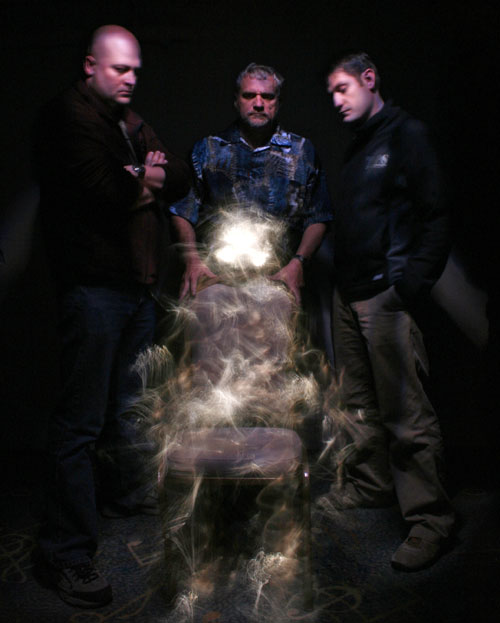
All right, so you might recognize two of these guys. That's Jason Hawes and Grant Wilson of Ghost Hunters fame (along with yours truly in the middle ) apparently interrogating a ghost at the Stanley Hotel in Estes Park, Colorado. Actually, it's a bit of trick photography (gasp!) produced by having us pose around an empty chair in a darkened room while the photographer (in this case, one Adam Blai—see other samples of his work at www.happyvalleystudio.com) opens the shutter and "paints" the entity with a light wand while we stood very, very still. If only all ghosts were that cooperative!  


TOP | GHOST HOME PAGE | HOME