RETURN
TO ODDS N' ENDS PAGE | E-MAIL
ME
PEARL
HARBOR: JAPAN'S GREATEST
VICTORY OR MOST PROFOUND BLUNDER?
While
the facts of history are usually easy to obtain, the meaning behind those facts
are frequently shrouded in mythology, a truism that makes any historian's job
that much more difficult. Perhaps no event in modern history better illustrates
this point than does Japan's attack on Pearl Harbor on December 7, 1941—a
watershed event in this nation's past which has been more thoroughly studied
and, frequently, misunderstood, than any other.
It has been traditionally taught that the attack utterly and completely destroyed
the American Pacific fleet, which is what made it possible for Japan to seize
much of Asia in just a few short months. Further, it is also widely taught that
Japan—starved of oil and scrap metal by American embargoes—was left
with no choice but to take out the American fleet in Hawaii in order to secure
the resources she was being denied, thus placing much of the blame for the attack
squarely on the United States.
Yet are these beliefs justified? While these two thoughts have been so thoroughly
enshrined within the public conscience that to challenge them is to effectively
question the authority of history itself, as time goes by and we are able to
examine the attack within the context of the geo-political situation of 1941,
these ideas begin to take on less validity. In fact, once all the details are
known, the case can be made that Japan's attack on Pearl Harbor may have been
not its greatest victory, but may have been, in fact, its greatest blunder.
Revisionist history? Perhaps, but once the facts are known, it quickly becomes
apparent how largely ineffective the attack really was in terms of rendering
the American Navy ineffective. While historians generally concur that Japan's
decision to take on a much larger, heavily industrialized opponent made her
defeat ultimately inevitable—thereby making the attack on Hawaii unwise
for that reason—may be valid, it misses the more immediate point. Japan's
defeat wasn't simply the result of taking on a materially superior foe far more
capable of waging a war of attrition than itself, but was a consequence of some
very significant errors made on the first day of the war. Japan lost the war
within hours of the first bombs being dropped, not 45 months later beneath the
mushroom clouds of Hiroshima and Nagasaki; in essence, Japan not only dropped
bombs at Pearl Harbor, but dropped the ball as well.
How
Serious Was the Damage?
Pictures of blazing battleships and wrecked aircraft have been so seared into
our collective consciousness that to hold to the idea that Japan's sneak attack
was anything but a complete and overwhelming success seems almost heretical.
However, do the grainy black and white photos of the damage wrought that terrible
December morning so long ago really give us the whole picture? Was the fleet
really crippled to the point that all further operations were out of the question,
as has been generally believed for over 65 years?
Considered with the larger context of what America possessed at the time, the
argument could be made aside from some significant but largely repairable damage
to American naval and air assets in Hawaii and with the exception of a few battleships
that were written off as permanent losses, the Pacific Fleet was left almost
untouched. Don't believe that? Then let's take a look at the facts: 96 naval
vessels were in the harbor when the attack began just a few minutes before 8
o'clock on December 7th, a force which included 8 battleships, 8 cruisers, 30
destroyers, 4 submarines, and a number of auxiliary ships and smaller combatants
(along with a host of service craft, tugs and barges of all types). While a
significant force, considering that at the time of the attack the United States
boasted a surface navy of approximately 225 combatants of all types (approximately
the same size it is today), this total actually constituted less than 15% of
total American naval assets. With the exception of America's battleship fleet—8
of 17 being in the harbor that morning—that means only a small part of
America's first line of defense was vulnerable that day, the rest being at sea
or safely berthed in west coast or Atlantic ports.
Further, while official records maintain that 21 ships were sunk or damaged
in the attack, only about a dozen sustained damage serious enough to keep them
out of commission for more than a few months, with the remainder of the fleet
emerging practically unscathed in the attack. Of course, the battleships did
take a beating that day and overall naval losses constituted the greatest single
day loss of shipping and lives in U.S. Naval history, but when compared to the
overall size of the fleet at the time, these losses were far from catastrophic.
Only three ships were permanent losses (the Arizona, Oklahoma, and old
target ship Utah), while three other battle wagons (the California,
West Virginia and Tennessee) a trio of cruisers, and a few destroyers
and auxiliary ships were put out of commission for any significant length of
time. This constituted less than a tenth of the ships in the harbor that morning,
which is a far cry from the "complete devastation" most commentators
describe. Further, when one considers that most of the damaged ships would be
repaired and seaworthy within a few months, the claim that the Pacific fleet
was destroyed could only be considered a huge exaggeration. Clearly, the thought
that the American Pacific fleet could be effectively put out of commission by
losing only a tiny fraction of its total naval assets is untenable, and since
the significant degradation of American military assets in the region was the
primary goal of the strike, the attack must be judged as significantly less
successful than historians have traditionally maintained.
Yet what of the battleships? Wouldn't the destruction or temporary incapacitation
of almost a third of the Navies' big battle wagons have to be considered a major
blow? They were, after all, the fleet's primary surface combatants and constituted
a significant chunk of total naval resources—especially in the Pacific—so
how could their loss be considered anything but catastrophic?
While the loss of five battleships and the resultant death of some 1,800 crewmen
that morning was tragic, it must be recognized that these ships were far from
being the powerful assets they are usually portrayed as being. Most were World
War One era dreadnoughts at the end of their service lives (the newest
of the them, the West Virginia, had been commissioned almost twenty years
earlier) and as such, most were on the verge of being scrapped. In fact, it
was probably the threat of war that had kept them from the wrecking yards as
long as it had. Despite numerous upgrades and extensive modernizations, the
fact of the matter is that these ships were clearly obsolete by 1941, a reality
which was demonstrated by the fact that all of the surviving Pearl Harbor battleships
all were either scrapped or sunk as targets within months of the end of hostilities,
clearly implying that their combat capabilities were considered fairly limited
even then. What Pearl Harbor saw was the demise of a weapons system that was
already becoming obsolete; their destruction served only to quicken their end
and underline their already diminished role.
As such, it's difficult to see how the sinking of a half dozen, obsolete battlewagons—ships
that would have been no match for Japan's best battleships in a head-to-head
confrontation in any case—could have significantly effected the naval power
of balance in the region. To better illustrate my point, consider that if there
had been no attack and these battleships had been available to confront the
Japanese navy in the opening months of the war, would the outcome likely have
been significantly different? I suspect they would not, which suggests that
if these ships would have made little difference in early months of the war
had been pressed into service, why do we imagine their loss on December 7th
constituted such a major setback?
But what of the effect on the Navy overall? Surely the loss of several capital
ships should have reduced American assets in the region considerably, thus tipping
the balance of power clearly in Japan's favor. Actually, however, considering
the overall size and strength of the American and Japanese navies after December
7th, the reality is that even after the attack America's navy was still larger
than that of Japan! For instance, at the time of the attack Japan possessed
seven fewer battleships than the United States, two-thirds as many destroyers
and only half as many submarines. Additionally, while it had just one more aircraft
carrier and a nearly identical number of cruisers, it lacked substantial auxiliary
and amphibious forces, and was hard pressed to keep its fleet at sea with the
limited oil resources on hand—a situation which was to improve little throughout
the war and even after Japan seized the oil fields of the Dutch East Indies.
Of course, the American Navy was split between two oceans whereas Japan could
commit her entire navy to the Pacific, but major units could have been shifted
to the Pacific theater fairly quickly had it been necessary (and until war production
came fully on line by late 1942). All things considered then, even with the
losses at Pearl Harbor the situation in the Pacific was nowhere near as bleak
as generally assumed; the fact is that Admiral Nimitz—Admiral Kimmel's
replacement as CincPac—still had an effective battle force at his disposal
and one that was still capable of challenging Japan's conquest of the Pacific
had it so chosen to do so.
Additionally, it's important to consider what didn't get destroyed in the attack.
None of the aircraft carriers that were to play such a vital role in the next
few months were in the harbor at the time, thus sparing America a genuinely
serious blow that would have taken some time to recover from. Additionally,
and perhaps even more significantly, the submarine base that was to make long-range
offensive operations against Japan's merchant fleet possible was left mostly
untouched—an oversight that was to cost Japan dearly in the end . Even
worse for Japan, few of the harbor's substantial repair facilities were seriously
damaged; fuel facilities and tank farms, dry docks, repair and machinery shops,
storage facilities, and most ammunition stockpiles were left untouched or only
slightly damaged in the attack, a fact that was to allow the Navy to repair
most of the ships that did sink in the shallow waters of the harbor that day
as well as retain its important status as a forward command center. Had the
Japanese taken out a large part of these facilities, it is likely America would
have been forced to relocate much of her fleet to the West Coast, further reducing
her response time to the rapidly changing situation in the Pacific and affording
Japan more time to consolidate her hold on the Far East.
As such, the claim that the Pacific fleet was virtually annihilated is a bit
of revisionist history in its own right. While the public has been led to believe
that the fleet had been badly crippled by the attack, in reality it still posed
a formidable threat to Japanese ambitions in the Pacific that could have proven
decisive in the first months of the war had it been used to its fullest advantage.
It was not the destruction of America's Pacific fleet that gave Japan a free
hand in the early months of the war but America's political leaders unwillingness
to risk its Navy further that not only made Asia ripe for conquest, but probably
extended the war by years and increased the casualty toll by hundreds of thousands.
From the White House down to on-scene commanders concerned with preserving their
careers, the entire armed forces seemed uncertain what to do in the weeks following
the attack, resulting in months of indecision and timidity on the part of American
commanders. With the exception of allocating a few ships in support of the overwhelmed
Dutch, British, and Australian naval forces in Dutch Indies, the American Navy
mostly stood by and watched while Japan seized the oil-rich Dutch colonies (now
modern day Indonesia), the Malay Peninsula, and the Philippines (the latter
of which resulted in tens of thousands of preventable American deaths). Even
a modest effort to evacuate tiny and largely indefensible Wake Island—a
plan put forward by Admiral Kimmel before he was relieved of command—was
canceled as being too risky, thereby effectively abandoning hundreds of marines
and civilian workers to their fate when the island fell on Christmas Day, 1941.
America was simply unwilling to risk its remaining fleet—though still substantial
and growing stronger each day—even to defend American territory and lives.
Had the true reality of the situation been known and the leadership in Washington
more resolute, Japan might well have found its conquest of the region stopped
in its tracks. In effect, Japan's early victories in the Pacific had less to
do with Pearl Harbor's success than it did with Washington's lack of resolve.
It truly was America's darkest hour.
Japan's
Missed Opportunities
Pearl Harbor is not about lost American opportunities, however, but about Japan's
failure to follow up on its initial successes. While American surface naval
assets had been only partially immobilized, American air assets had been largely
wiped out, leaving the skies over Hawaii clear of American aircraft. Further,
with the harbor ablaze with burning ships, central command in disarray, and
what anti-aircraft fire the fleet could put up proving to be only marginally
effective, Hawaii was especially vulnerable to follow-up attacks. That was when
Japan had its best opportunity to not only finish the job, but to truly hurt
America's war fighting capability.
There were four things Japan could have done that, if not ensuring victory,
would have made it far more difficult for America to have ultimately defeated
her. These are, in descending order of importance, as follows:
- The Japanese
pilots needed to include more than just the battleships in their target
list. Obviously, the battleships were important, but most of them had been
sunk or damaged within the first half hour of the attack and no longer posed
a significant threat, at which point the pilots needed to move on to other
important and largely untouched targets. For example, had they paid more
attention to the submarine pens and the extremely vulnerable tankers and
repair ships that dotted the harbor, they would have hurt the fleet far
worse than they did. By way of example, the tanker Neosho, fully
loaded with high octane aviation fuel and berthed in the middle of battleship
row, would have set the east harbor ablaze had the Japanese considered putting
even a single torpedo into her. As it was, she was left untouched. In essence,
the Japanese pilots were so intent on destroying the high profile targets
that they overlooked a wealth of targets available to them, which was to
ultimately prove to be a mistake far more disastrous to Japanese territorial
aspirations than might have been imagined.
- Japan needed
to have gone forward with the third wave of its air assault as originally
planned (but one that Admiral Nagumo—as on-scene commander—canceled).
Japan's greatest failure at Pearl Harbor was that it left the base's extensive
repair and support facilities intact, which not only permitted the Navy
to eventually refloat and repair most of the ships lost that day, but allowed
Pearl Harbor to continue to operate as a fully functional forward base.
This oversight remains to this day one of the gravest mistakes Admiral Nagumo—a
man who was to eventually develop a reputation for making timely and indefensible
errors in judgment throughout the war—was to make that day.
- In yet another
example of Japan's willingness to use untried equipment and risky tactics
when they had something better on hand, it put its trust in the tiny and
ultimately unsuccessful mini-subs, which proved not only incapable of sinking
even a single ship, but almost compromised the entire mission by being detected
just hours before the attack . Had Japan instead chosen to park its large
and powerful I-class submarines off the harbor entrance (Japan had nine
of these boats on hand) they might well have caught several ships outside
the harbor entrance as they sortied for the open sea and sunk them in deep
water where they would have been unrecoverable. Had they been left to loiter
off the harbor mouth, they might also have caught Halsey's carrier group
as it entered the harbor that evening. Japan's failure to take full advantage
of her substantial submarine fleet was to prove an oversight that would
plague her throughout the war.
- Considering
the decisive role the aircraft carriers were to play later in the war, the
failure to sink any of the big flat tops was a major missed opportunity
that would ultimately cost the Japanese dearly. Surely Nagumo could have
made some effort to search for these missing units during his return voyage
to Japan, especially considering the huge advantage in planes and ships
he possessed over the American carrier task forces then out to sea. Of course,
he couldn't have known precisely where the American carriers were located,
but he should have been able to surmise from their absence at Pearl Harbor
that they had to be at sea somewhere to the west of Hawaii. All that would
have been required was for the fleet, then, was instead of retracing its
northerly course back to the Kirile Islands, to steer a more southerly course
back to Japan—one that would have taken it close to Midway Island and
Guam—where, with a bit of luck, it might have found both Halsey's inbound
Enterprise (then a mere 200 miles west of Oahu at the time) and possibly
even caught Lexington enroute to Midway as well. Operating independently
and with only minimal screening forces, either carrier would have made an
easy target for Nagumo's overwhelmingly superior force of six carriers and
thirty escorts. While this might have been a risky adventure and Nagumo's
carriers were urgently needed elsewhere, the opportunity to take out one
or even two of the American carriers should have been worth the risk.
Was
the Attack Necessary at All?
Perhaps the greatest tragedy of all was that Japan need never have attacked
Pearl Harbor at all to have realized its dreams of conquest in the South Pacific.
The rationale that it needed to take out the American fleet in order to have
a free hand in the Pacific was, in the end, a flawed supposition. Few Americans
wanted a war with Japan, and almost no politician in Washington was willing
to permit American blood to be spilled over the Malay Peninsula and the oil-fields
of the Dutch East Indies. If America wasn't willing to go to war to defend England
from Nazi Germany, what reason did Japan's leadership have for imagining that
it would be so willing to defend some far-flung Dutch possessions in the Pacific?
After all, Japan had already demonstrated that America had no stomach for war
when it watched silently as Japan seized French Indochina and Siam a few months
earlier. As such, had Japan simply bypassed the Philippines and other American
possessions in the region and took what it wanted, it is extremely doubtful
Roosevelt would have been able to get the two-thirds majority in Congress needed
to declare war on Japan, even had he been so inclined to try. The pacifist movement
in America was strong and while the conquest of the Far East might have resulted
in a complete rupture in relations between America and Japan, it would have
been unlikely to have resulted in anything approaching full-blown war. It simply
doesn't follow that it would.
And that's the real tragedy of December 7th, 1941. Japan could have taken everything
it wanted without dropping a single bomb on battleship row. It may have meant
war with Britain, perhaps, as it seized British colonies in the Far East, but
that was a war it could easily have won against a country that was barely holding
its own in Europe and one that lacked the resources to properly defend her oversees
colonies. Had Japan been a bit more cunning and patient, by June of 1942 she
probably would have had possession of an empire that stretched from Manchuria
to New Guinea and from the Solomon Islands to the border of India, all with
scarcely a shot being fired. Japan threw away its empire in the process of acquiring
it, all because it overestimated both America's willingness to contest her expansionist
plans and the real threat it posed to those plans. America was a sleeping giant
that only an attack on her own soil could have awoken; Japan would have been
wise to have left her to slumber.
Conclusion
Whether Japan's attack on Pearl Harbor was necessary can be debated forever,
but what can't be denied is that the traditional belief that the Pacific Fleet
was destroyed on December 7, 1941 can no longer be maintained with anything
approaching historical integrity. The American navy remained largely intact
after the attack and still constituted a significant impediment to Japanese
ambitions in the Far East. The fact that it failed to be so was simply a result
of a marked lack of resolve. Obviously, war with Japan would have been a brutal
and bloody affair even under the best of conditions, but with determination
and a bit of luck, the conflict could have been shortened by months—if
not years—and the situation in the region altered radically had America
acted forcefully in the early months of the war. The fact that it didn't has
less to do with the effectiveness of Japanese bombs and torpedoes than to the
political timidity and military second-guessing that normally results from such
an unexpected defeat, thus making the decision to surrender the South Pacific
to Japan without a fight a political rather than a military one. Wars are not
won by timidity; a lesson the first months of 1942 was to make abundantly clear
to the United States, and one it would be forced to relearn again in Korea,
Vietnam, and Somalia.
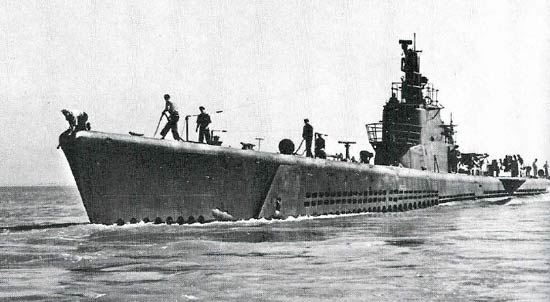 |
U.S.S.
Tautog: The One That Got Away
Of
all the ships in Pearl Harbor on December 7th, one vessel Japan failed
to target that morning was to ultimately come back to haunt her in
a major way. Tied up alongside the submarines Narwhal, Dolphin,
and Cachalot at the submarine yard was the U.S.S. Tautog
(SS-199), a "Tambor" class fleet submarine that, unbeknownst
to the Japanese, was to play a far more prominent role in the coming
years than any of the ships that were to survive that day. Not only
was it to be credited with assisting the Cachalot and the destroyers
with downing one of the attacking planes that morning, but she would
go on to become one of the top "aces" of the American submarine
fleet. During the course of thirteen war patrols over the next four
years, the Tautog would be credited with sinking no fewer than
26 Japanese ships—including the destroyer Shirakumo and
two submarines—along with over 76,000 tons of shipping, making
her the all-time leader for total number of enemy ships sunk and eleventh
in terms of tonnage sent to the bottom. The significance of this statistic
cannot be understated: Tautog—a vessel that would have
made an easy and plump target for Japanese bombers had their pilots
been less intent on attacking only the more high profile targets—was
to sink more Japanese ships than all the other Pearl Harbor survivors
combined! In the end, it may be that overlooking the small, gray
boat was to cost the Japanese more dearly than any other opportunity
it missed that day.
|
Related article:
Was Admiral Kimmel Properly Held Responsible for the Attack on Pearl Harbor?
Click here
to find out.
SUGGESTED
READING:
At Dawn We Slept by Gordan W. Prange, Penguin Books (Reprint)
Pearl Harbor: The Continuing Controversy by Hans Trefousse, Kreiger Publishing
Pearl Harbor: Final Judgment by Henry Clausen, De Capo Press
Infamy by John Toland, Berkley Press (Reprint)
TOP
| ODDS N' ENDS PAGE | HOME